
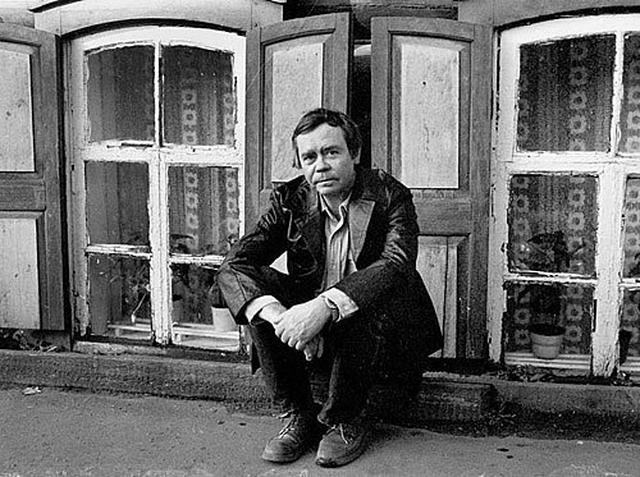
For Valentin Rasputin, a village was never merely a collection of houses. It contained memory, ancestors, graves, language, customs, relationships, and the accumulated knowledge of generations who had learned how to live beside a particular river or forest. When a village disappeared, something more than property was lost. A way of understanding the world disappeared with it.
Born on March 15, 1937, in Ust-Uda in Eastern Siberia, Rasputin became one of the most important representatives of the Soviet literary movement usually known as Village Prose. His fiction repeatedly returned to rural communities confronting modernization, displacement, war, moral compromise, and the weakening of traditional bonds. Works including Money for Maria, The Last Term, Live and Remember, Farewell to Matyora, “French Lessons,” and The Fire made him one of the most prominent Russian prose writers of the 1970s and 1980s. His childhood along the Angara River gave that literary world an unusually personal foundation: the places he remembered were themselves transformed by the enormous hydroelectric projects reshaping Siberia.
🌲 A Childhood Beside the Angara
Valentin Grigoryevich Rasputin was born in Ust-Uda, in what is now Irkutsk Oblast. His parents were Grigory Nikitich Rasputin and Nina Ivanovna Rasputina. When Valentin was still very young, the family moved to Atalanka, a village along the Angara River where relatives on his father’s side lived and where much of his childhood unfolded.
The Siberian landscape became one of the permanent foundations of his imagination. Rivers were roads, food sources, boundaries, dangers, memories, and markers of community. The taiga stood close to everyday life rather than existing as distant wilderness. Fishing, gathering berries and mushrooms, traveling by boat, enduring severe winters, and depending upon neighbors belonged to the practical rhythms of rural existence.
Rasputin would later be known for writing elegiacally about disappearing villages, but his attachment to rural life was not created from abstract nostalgia. He had grown up inside the kind of community he later depicted, and he knew that village life could be difficult, poor, demanding, and restrictive as well as communal and beautiful.
That complexity prevented his strongest fiction from becoming mere pastoral fantasy.
🏫 Leaving Home for School
Rasputin attended the small elementary school in Atalanka through the fourth grade. Continuing his education required leaving home for Ust-Uda, roughly fifty kilometers away, because there was no secondary school in his village. The Russian State Library notes that he remembered arriving there as a shy village boy who had never previously lived apart from his family.
That experience later provided the autobiographical foundation for one of his most beloved stories, “French Lessons.”
Leaving Atalanka introduced a theme that would recur throughout Rasputin’s writing: the cost of separation from home. Education, opportunity, industry, and modernization could improve lives, but advancement often required leaving behind the places and relationships that had made those lives intelligible.
Rasputin never treated change as automatically evil.
He did insist that progress had consequences.
His fiction asks who pays those consequences and whether anything valuable disappears before society realizes it should have been preserved.
🎓 Irkutsk State University
In 1954, Rasputin entered the history and philology faculty of Irkutsk State University. He initially expected to become a teacher, but journalism gradually pulled him in another direction.
While still a student, he began contributing to the newspaper Sovetskaya Molodyozh. After graduating in 1959, he joined the newspaper’s staff and later worked in journalism and broadcasting in Irkutsk and Krasnoyarsk. The work took him across Siberia and placed him in direct contact with remote communities, industrial projects, workers, construction sites, rivers, and settlements undergoing rapid transformation.
Journalism taught Rasputin to observe closely and listen to speech.
Both skills became essential to his fiction.
His characters rarely sound like interchangeable literary creations. They carry rhythms of rural conversation, regional vocabulary, hesitations, proverbs, repetitions, and the practical intelligence of people accustomed to physical work.
Rasputin’s Siberia is therefore built not only from landscape.
It is built from voices.
📰 From Reporter to Fiction Writer
Rasputin began publishing journalistic pieces while still at university and gradually moved toward short fiction. His first stories appeared during the early 1960s, while his growing reputation was strengthened by participation in a young writers’ seminar in Chita in 1965.
Writer Vladimir Chivilikhin encouraged him and helped bring his work to greater attention. By the middle of the decade Rasputin had begun moving from regional journalism toward a full-time literary career.
His early stories frequently focused on Siberian people and landscapes, but the writing soon deepened into questions about responsibility, family, money, death, memory, and the moral obligations that hold small communities together.
These were modest subjects only in scale.
Rasputin understood that a village crisis could contain an entire ethical world.
💰 Money for Maria
Rasputin’s breakthrough came with Money for Maria, published in 1967.
The story begins with a practical emergency. Maria, who runs a village shop, is discovered to have a serious financial shortfall in the store’s accounts. Her husband, Kuzma, must somehow raise the money quickly enough to prevent devastating consequences for the family.
The plot is simple.
Its moral implications are not.
Kuzma approaches relatives, neighbors, acquaintances, and institutions for help. Each response reveals something about the relationships holding the community together. Money becomes a measure not merely of wealth but of obligation.
Who helps?
Who refuses?
Who offers excuses?
What does one neighbor owe another?
Rasputin could take an apparently small financial problem and turn it into a test of an entire community’s moral structure.
That ability became characteristic of his fiction.
👵 The Last Term
Published in 1970, The Last Term centers on an elderly woman, Anna, who appears to be dying. Her adult children return home, gathering around the mother whose life had once formed the center of their family.
Rasputin uses the impending death to explore what happens when children move away from the world that formed them.
Anna belongs to an older rural generation defined by work, family obligation, endurance, memory, and connection to place. Her children have entered different lives.
Their return creates proximity without necessarily restoring the intimacy of the past.
The family is physically together.
Time has already separated them.
Rasputin’s older women frequently possess a moral weight that does not depend upon education, political authority, or wealth. They remember who belongs to whom. They know where people came from. They understand traditions younger characters have begun treating as inconvenient.
When such a character dies, an entire archive disappears.
🍞 “French Lessons”
Rasputin’s 1973 story “French Lessons” drew directly upon experiences from his childhood.
Its young narrator leaves his village to continue his schooling and finds himself living away from home during a period of severe poverty. He is intelligent and determined but frequently hungry.
A French teacher notices.
What follows becomes an unusually delicate story about dignity and generosity. The teacher wants to help the boy, but straightforward charity threatens to humiliate him. She therefore searches for ways of giving without making the recipient feel reduced by the gift.
The story became one of Rasputin’s most widely read works and eventually entered the Russian school curriculum.
Its emotional strength comes from restraint.
Kindness is not presented as a grand heroic act.
It is one person noticing that another person is hungry and trying to help without destroying his pride.
For Rasputin, morality often begins at exactly that scale.
⚔️ Live and Remember
Published in 1974, Live and Remember brought Rasputin another major success and later earned him the USSR State Prize.
The story takes place near the end of World War II and centers on Andrei Guskov, a soldier who deserts and secretly returns to the area near his Siberian village. His wife, Nastena, discovers his presence and becomes trapped between loyalty to her husband and the demands of the community surrounding them.
Rasputin refuses to turn the situation into a simple moral lesson.
Desertion during wartime carries enormous consequences.
Yet Andrei remains human.
Nastena’s loyalty is understandable.
The village’s expectations are understandable.
Fear, shame, love, survival, secrecy, and responsibility become tangled together until no decision can remain private.
The title itself carries an ethical command.
To live is not enough.
One must remember what has been done.
🧠 Memory as Moral Responsibility
Memory occupies a special position throughout Rasputin’s work.
Remembering is not merely sentimental.
It creates responsibility.
If people remember where they came from, who sacrificed for them, how their community survived, and what happened to those who lived before them, then certain actions become more difficult to justify.
Forgetting provides freedom of another kind.
A place can be demolished more easily when its history is forgotten.
A river can be transformed when its relationship to a community becomes invisible.
Parents can be abandoned when their sacrifices disappear from memory.
Rasputin feared this kind of forgetting because it loosened the bonds connecting people across generations.
Modernization could alter landscapes quickly.
Memory resisted at a slower speed.
🌊 The Flooding of the Angara Villages
One of the most important facts behind Rasputin’s writing was intensely personal.
Large hydroelectric projects built along the Angara River during the Soviet period created enormous reservoirs. Communities in areas scheduled for flooding had to be relocated, including the villages connected with Rasputin’s childhood. The old Atalanka was among the settlements affected by construction of the Bratsk hydroelectric project.
The engineering achievements were immense.
So were the human consequences.
Houses could be rebuilt elsewhere.
Roads could be moved.
People could receive replacement property.
But what happens to the cemetery containing generations of relatives?
What happens to the tree planted beside a particular house?
What happens to the stories attached to a shoreline that will soon lie underwater?
These questions became the emotional foundation of Rasputin’s masterpiece.
🏝️ Farewell to Matyora
Published in 1976, Farewell to Matyora centers on an island village that is scheduled to disappear beneath the waters of a new reservoir created for hydroelectric development.
The authorities regard the evacuation as an administrative problem.
The villagers, particularly the elderly, understand it differently.
Matyora contains their homes, fields, graves, memories, and relationships with generations of people who have lived there before them.
Moving away is therefore not equivalent to changing addresses.
The elderly Darya becomes one of the story’s moral centers. For her, the destruction of Matyora is inseparable from responsibility toward the dead and toward those who will come afterward.
The question is not whether modern development can be stopped forever.
The question is whether a society that destroys its memory in the name of progress understands what progress actually costs.
⚡ Progress and Its Price
Farewell to Matyora became one of the defining works of Village Prose because it refused a simple assumption common to narratives of modernization: that newer automatically means better.
Electricity is useful.
Hydroelectric power can transform entire regions.
Industrialization can provide employment and infrastructure.
Rasputin does not need to deny any of this for the story’s central tragedy to remain valid.
Something is gained.
Something is destroyed.
The moral problem begins when only the gain is counted.
This is one reason Farewell to Matyora remains relevant far beyond its Soviet setting. Communities around the world continue to face displacement through dams, mining, urban development, transportation projects, climate pressures, and changing economies.
The technology changes.
The question remains recognizable.
What is a place worth to the people whose memories live there?
🌿 Village Prose
Rasputin became one of the leading figures of Village Prose, a broad literary tendency that emerged in Soviet literature after the Stalin era.
Writers associated with the movement frequently came from rural backgrounds and wrote about villages transformed by collectivization, war, migration, mechanization, urbanization, and industrial development. Among the important names associated with Village Prose were Fyodor Abramov, Vasily Belov, Viktor Astafyev, and Rasputin.
The movement was never simply a celebration of rural innocence. Its strongest writers were interested in what modernization erased as well as what it created.
Scholar Kathleen Parthé has described Village Prose as a literature deeply concerned with disappearing rural ways of life, environmental preservation, traditional culture, and anxieties about Russia’s future.
Rasputin gave those concerns some of their most memorable fictional forms.
👵 The Old Women Who Remember
Again and again, Rasputin placed older women near the moral center of his stories.
They were rarely powerful in any official sense.
They did not control factories.
They did not run ministries.
They did not make development plans.
Yet they knew things the official decision-makers often did not.
They remembered births and deaths.
They knew whose house had belonged to which family.
They maintained rituals surrounding food, burial, hospitality, work, and seasonal life.
They carried a community’s unwritten history.
This made them dangerous witnesses to careless progress.
A bureaucratic document could describe a village as territory scheduled for flooding.
An old woman could name every family who had lived there.
Both descriptions might be factually correct.
Only one conveyed what was actually being destroyed.
🔥 The Fire
Rasputin returned to questions of social disintegration in The Fire, published in 1985.
The story is set in a settlement created partly by the forces of relocation and modernization that had shaped his earlier work. A warehouse complex catches fire, and the emergency reveals something disturbing about the community.
Instead of automatically cooperating, people steal.
Order breaks down.
Property disappears.
The fire becomes both an actual disaster and a test exposing moral deterioration.
If Farewell to Matyora asks what happens when a traditional community is physically destroyed, The Fire asks what happens after people have already been uprooted.
A new settlement can provide buildings.
It cannot automatically recreate belonging.
Rasputin feared that once the older web of obligations had been severed, individuals might become socially rootless.
The disaster then becomes internal.
🌲 Lake Baikal and Environmental Activism
Rasputin’s concern for Siberian landscapes extended beyond fiction.
He became an outspoken participant in environmental campaigns, particularly those connected with the protection of Lake Baikal and opposition to large-scale schemes that threatened Siberian rivers and ecosystems. Scholars of Village Prose have identified environmental preservation as an important dimension of the movement, while biographical sources emphasize Rasputin’s own sustained involvement with Baikal.
His environmental thinking was inseparable from culture.
A river was not valuable only because of water quality.
A lake was not valuable only because of biodiversity.
Landscapes also held human memory, language, stories, burial places, livelihoods, and ways of life.
Environmental destruction could therefore become cultural destruction.
Rasputin understood ecology before the term became commonplace in literary conversation as a relationship between natural systems and human communities.
📘 Siberia, Siberia
Rasputin explored these concerns directly in Siberia, Siberia, a collection of essays published in Russian in 1991 and later translated into English.
The book moves through Siberian history, geography, culture, settlement, industrialization, environmental damage, and regional identity.
Its subject is enormous.
Siberia is not merely wilderness.
It contains Indigenous peoples, Russian settlement, rivers, prisons, industries, cities, villages, forests, religious traditions, imperial history, Soviet development, and competing ideas about what the land is for.
Rasputin’s relationship with the region was deeply emotional, but the essays also reflect his fear that Siberia could be treated merely as a warehouse of resources.
Timber.
Minerals.
Water.
Energy.
Land.
A region understood only through extraction eventually becomes difficult to call home.
⛪ Tradition, Religion and Cultural Identity
As Rasputin grew older, Russian Orthodox Christianity and the preservation of traditional Russian culture became increasingly visible in his public life and essays.
These interests grew naturally from themes already present in his fiction: ancestors, burial, obligation, continuity, sacrifice, community, and the idea that people inherit responsibilities they did not personally choose.
At the same time, his public positions became more politically controversial during the late Soviet and post-Soviet periods. He opposed significant aspects of the reforms of the Gorbachev era and became associated with conservative and nationalist currents within Russian public life. Scholars have interpreted this later political evolution differently, with some emphasizing continuity with his defense of community and tradition and others criticizing the nationalist implications of that outlook.
That later history complicates his legacy.
It should not be erased.
Nor does it reduce the earlier fiction to a political slogan.
The novels and stories remain more morally complex than any simple ideological label.
🗳️ A Writer in Public Life
During the final years of the Soviet Union, Rasputin moved beyond literary and environmental advocacy into formal public life, serving as a People’s Deputy of the USSR in 1989–1990. He increasingly criticized the direction of political and cultural reform and argued for the preservation of Russian national traditions.
This period divided readers and critics.
Some regarded Rasputin as a defender of cultural continuity in a society undergoing destabilizing change. Others saw elements of the late Village Prose movement becoming entangled with exclusionary nationalism and reactionary politics.
Both contexts matter when considering his later reputation.
Writers do not always remain contained inside the meanings readers first find in their books.
Rasputin’s literary defense of home, memory, and tradition eventually became part of a larger public worldview whose political implications continue to be debated.
🎥 Rasputin on Film
Several of Rasputin’s works were adapted for film and television.
“French Lessons” became a 1978 film directed by Yevgeny Tashkov, while Farewell to Matyora inspired the film Farewell, associated ultimately with director Elem Klimov after the death of his wife and fellow filmmaker Larisa Shepitko during production.
Film adaptation suited Rasputin because landscape matters so intensely in his fiction.
A river is never background scenery.
A village house carries history.
A forest edge defines the limits of a known world.
Cinema could make that physical relationship between people and place immediately visible.
Yet the emotional difficulty remained the same.
How does one show memory?
Rasputin’s answer was often to show what people were about to lose.
🏆 Recognition in the Soviet Union and Russia
Rasputin received substantial official recognition during his lifetime.
Live and Remember brought him the USSR State Prize in 1977, and he received another USSR State Prize in 1987 for The Fire. He was named a Hero of Socialist Labour in 1987 and later received major honors from the Russian state, including the Russian State Prize in literature and the arts.
The recognition creates an interesting contrast with the critical edge of his fiction.
Rasputin was not an underground dissident writer in the manner of some Soviet authors whose works circulated primarily through samizdat or exile publishing.
His books appeared within the Soviet literary system and reached large audiences.
Yet they could still question some of the assumptions underlying official narratives of progress.
That ambiguity was part of what made Village Prose possible.
Criticism could emerge from inside cultural institutions rather than only from outside them.
🏠 Ivan’s Daughter, Ivan’s Mother
Rasputin continued writing fiction into the post-Soviet period.
One of his important later works, Ivan’s Daughter, Ivan’s Mother, appeared in 2003. By then, the social world surrounding him had changed dramatically.
The Soviet Union no longer existed.
The collective institutions of the village were transformed.
Market economics, political upheaval, crime, migration, and rapidly changing cultural values created another form of social dislocation.
Yet Rasputin’s fundamental question remained recognizable.
What holds people together when inherited structures disappear?
The later work is darker and more overtly shaped by his conservative worldview, but it continues his long-standing concern with family, moral responsibility, violence, and the consequences of social rupture.
The village had changed.
The anxiety about uprooted people remained.
🌊 Home as More Than Geography
Rasputin’s writing repeatedly suggests that a home is created through accumulated relationships rather than architecture alone.
A replacement house may be larger.
A new road may be smoother.
A modern apartment may provide conveniences unavailable in an old village.
Still, none automatically replaces a place where generations have buried their dead, remembered family stories, developed customs, and learned how to read the landscape.
This does not mean nobody should ever move.
Rasputin himself left home for education.
Millions of people have improved their lives through migration.
His fiction asks something subtler.
When people move voluntarily, they carry complicated losses.
When institutions force communities to move, those losses become matters of public responsibility.
Progress should be capable of remembering what it destroys.
🧭 The Moral Geography of Siberia
Siberia in Rasputin is not simply a dramatic landscape.
It is a moral geography.
Distance matters because people depend upon one another.
Winter matters because mistakes can become dangerous.
Rivers matter because they shape transportation, food, settlement, and identity.
Isolation can produce hardship, but it can also produce forms of mutual dependence difficult to reproduce in anonymous urban environments.
Rasputin sometimes idealized aspects of this older world, and critics have rightly questioned the extent to which Village Prose turned rural memory into a lost moral ideal.
Yet the questions underlying that nostalgia remain important.
What social obligations disappear when communities become more mobile?
What knowledge disappears when landscapes are radically altered?
Can modernization preserve memory rather than simply replacing it?
Rasputin never found easy answers.
That is why his best fiction survives the historical debates surrounding it.
🕯️ His Final Years
Rasputin remained closely associated with Irkutsk and Siberian cultural life throughout his later years.
He continued writing essays, participating in literary and cultural events, and speaking about Lake Baikal, Russian culture, language, religion, and the preservation of historical memory.
His life also contained profound personal losses. His daughter Maria died in the 2006 crash of S7 Airlines Flight 778 in Irkutsk, and his wife Svetlana died several years later.
By then Rasputin had become a literary elder whose public reputation extended well beyond the fiction that had first made him famous.
The young journalist who once traveled through rapidly changing Siberia had become one of the region’s most recognizable cultural voices.
🕯️ The Death of Valentin Rasputin
Valentin Rasputin died in Moscow on March 14, 2015, one day before his seventy-eighth birthday. He was buried several days later at the Znamensky Monastery in Irkutsk, returning in death to the Siberian region that had shaped nearly everything he wrote.
The timing added an almost literary symmetry to his biography.
March 15 marked his birth.
He died on March 14.
But the greater circle was geographical.
Ust-Uda.
Atalanka.
Irkutsk.
The Angara.
Baikal.
Even when Rasputin traveled or wrote about national questions, Siberia remained the landscape through which he understood home.
📚 Rasputin After Rasputin
Rasputin’s work continues to occupy an important place in Russian literary scholarship, education, museums, archives, and regional cultural life.
The Valentin Rasputin Museum in Irkutsk preserves manuscripts, photographs, biographical material, and scholarship connected with his career. His fiction has been translated into dozens of languages, and works including “French Lessons,” Live and Remember, and Farewell to Matyora continue to be read both as literary texts and as documents of enormous social transformations in twentieth-century Russia.
International readers may encounter him less frequently than Tolstoy, Dostoevsky, Chekhov, or Solzhenitsyn, but his work offers something particularly valuable.
Rasputin shows modernization from the viewpoint of people standing where the water is about to rise.
🌟 Why Valentin Rasputin Still Matters
Valentin Rasputin matters because the conflicts at the center of his fiction have not disappeared.
Governments still build dams.
Communities are still relocated.
Young people still leave rural regions for cities.
Languages and customs still weaken when populations disperse.
Economic development still creates benefits that are distributed unevenly.
Environmental decisions still affect people whose attachment to land cannot be measured easily in money.
Families still discover that physical distance gradually becomes emotional distance.
Rasputin’s answer was not that society should freeze history.
His strongest fiction offers something more useful than that.
It asks that change remember what it is changing.
🎂 Remembering Valentin Rasputin
Born on March 15, 1937, Valentin Rasputin grew up beside the Angara River in a Siberian world that would later be physically transformed by enormous hydroelectric projects. He left his village for school, studied literature and history at Irkutsk State University, became a journalist, traveled through Siberia, and eventually transformed the people and landscapes he knew into some of the most important Russian fiction of the late Soviet period.
Money for Maria examined community through financial crisis. The Last Term explored family and generational separation. “French Lessons” turned childhood hunger into a story about dignity and compassion. Live and Remember examined love, desertion, secrecy, and moral responsibility during wartime. Farewell to Matyora transformed the flooding of a village into an unforgettable meditation on memory, development, and belonging. The Fire asked what remained after the older communal world had already begun falling apart.
His later political positions remain part of a complicated legacy and continue to invite debate, but the literary questions that made Rasputin important extend beyond those arguments. His best work asks what humans owe to places, to families, to the dead, to nature, and to one another.
A village can disappear from a map.
The river can cover the road that once led to it.
The houses can be dismantled.
The people can move.
Yet memory resists the official declaration that the place no longer exists.
Valentin Rasputin built much of his life’s work from that resistance.
In his fiction, remembering becomes an act of responsibility.
And the vanished village remains visible because someone refused to forget it.

“As the soil was renewed, so one’s feelings seemed to change, uniting in some inexplicable way with a distant age when the eyes and ears of men were more alert to sights, sounds, and fine distinctions.”
-Valentin Rasputin, Money For Maria And Borrowed Time: Two Village Tales
🔗 Related Articles
- Sergei Dovlatov: Remembering the Writer of Exile, Absurdity & Everyday Life
- Andrei Voznesensky, One of Russia’s Greatest Poets
📚 Sources & Further Reading
- Valentin Rasputin Museum — Biography
- Boris Yeltsin Presidential Library — Valentin Rasputin
- Russian State Library — Valentin Rasputin and “French Lessons”
- Store norske leksikon — Valentin Rasputin
- Treccani — Valentin Rasputin
- Princeton University Press — Russian Village Prose: The Radiant Past
- Northwestern University Press — Siberia, Siberia


