
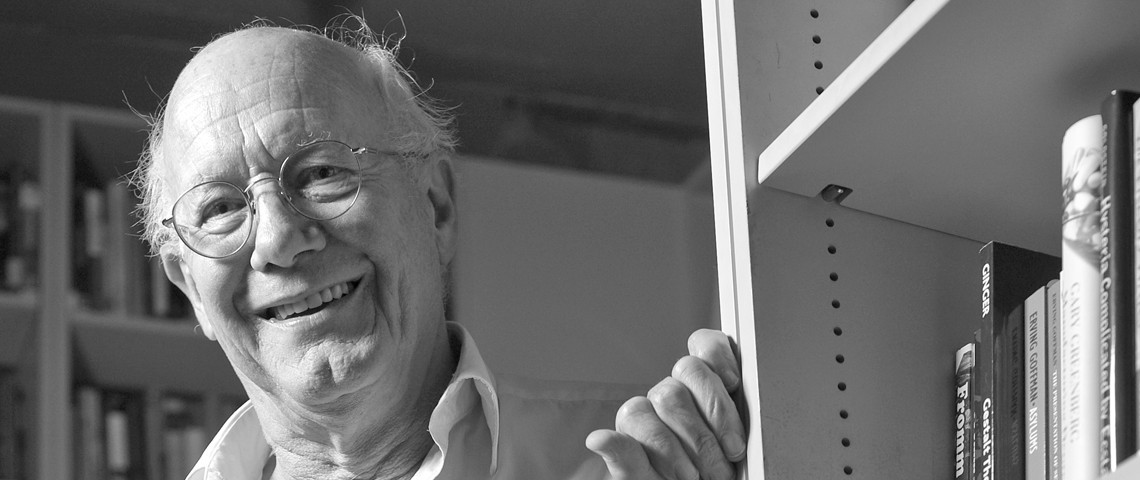
Born on September 18, 1933, Christopher Ricks has spent more than seven decades doing something deceptively simple: paying extraordinarily close attention to words.
That attention has taken him from John Milton and John Keats to Alfred, Lord Tennyson, T. S. Eliot, Samuel Beckett, and Bob Dylan. Along the way, Ricks became one of the most respected literary critics of his generation, a celebrated teacher and editor, the Oxford Professor of Poetry, and a scholar whose work demonstrates how much can be discovered when we slow down and genuinely listen to language.
Today, September 18, 2026, Sir Christopher Ricks celebrates his 93rd birthday. His long career offers a wonderful reminder that literary criticism need not be about reducing a poem to a theory or finding a single hidden meaning. At its best, criticism can be an act of attention—an effort to notice how rhythm, sound, punctuation, allusion, ambiguity, repetition, and even an apparently ordinary word can change the way a piece of writing lives in the mind.
📚 A Childhood Filled With Books
Christopher Bruce Ricks was born in Beckenham, Kent, England, in 1933. His childhood coincided with the Second World War, and much of his early education took place at boarding school. Books became an important refuge, and reading developed into something far more lasting than a childhood pastime.
Ricks later recalled that his love of books came before any conscious decision to become an academic. Literature offered companionship, fascination, and a world large enough to disappear into. After school, he completed National Service with the Green Howards in the British Army, spending part of that period in Egypt.
He then entered Balliol College, Oxford, where he studied English and became the first member of his family to attend university. Oxford provided an environment in which his instinctive love of literature could develop into the disciplined practice of literary criticism. He graduated with first-class honors and continued with postgraduate study, beginning an academic life that would eventually stretch across Britain and the United States.
The essential habit that would define his career was already taking shape: read carefully, notice everything, and resist the temptation to hurry past the words themselves.
🔎 The Art of Close Reading
The phrase “close reading” can make literary criticism sound more intimidating than it really is. At its heart, the practice asks readers to pay close attention to what a writer actually put on the page.
Why this word rather than another?
Why does a sentence pause here?
Why does a rhyme return at precisely this moment?
Does a phrase quietly echo an older poem?
What happens when a writer repeats a word but changes its meaning?
Ricks built much of his career around questions like these. His criticism is famous for noticing verbal connections that other readers might easily pass over. He is particularly interested in allusion—the way one writer’s language can recall another writer across decades or centuries—and in the subtle ways words accumulate meaning through repetition, association, rhythm, and context.
This approach may sound microscopic, but Ricks has repeatedly shown that very small details can open enormous literary questions. A single word can connect a modern poem with Shakespeare. A rhyme can reveal an emotional tension that a poem never states directly. A revision made between two editions can show how a writer reconsidered an idea.
For Ricks, attention to detail does not make literature smaller. It makes it larger.
✍️ From Milton and Keats to Tennyson
Ricks established his scholarly reputation early. His first major book, Milton’s Grand Style, published in 1963, examined the language of John Milton with the kind of careful stylistic attention that would become characteristic of his work.
Milton was only the beginning.
Ricks became particularly important as a scholar of Alfred, Lord Tennyson, producing influential critical work as well as a major scholarly edition of Tennyson’s poetry. His attention to Tennyson helped demonstrate the extraordinary craftsmanship beneath poems that could sometimes be dismissed as merely polished examples of Victorian verse.
Ricks listened to Tennyson’s poetry almost musically. Sound mattered. Rhythm mattered. Repeated words mattered. The exact placement of a phrase mattered. He treated poetic form not as decoration added to meaning, but as one of the primary ways meaning is created.
John Keats became another important subject. In Keats and Embarrassment, Ricks explored aspects of Keats that literary criticism had often passed over, including awkwardness, embarrassment, physicality, social discomfort, and the surprisingly complicated emotional work performed by seemingly small linguistic choices.
This willingness to take an apparently minor feature seriously became one of Ricks’s great critical strengths. Instead of approaching a poet with a predetermined system and making the poems fit it, he began with the writing and followed where the language led.
🎓 A Distinguished Academic Career
Ricks taught at several of Britain’s most important universities before building the later part of his career in the United States. He held positions at Oxford, became Professor of English at the University of Bristol, and later served as King Edward VII Professor of English Literature at the University of Cambridge.
In 1986, he moved to Boston University, where he became the William M. and Sara B. Warren Professor of the Humanities. His work there has combined teaching, criticism, scholarship, and textual editing.
Editing may sound less glamorous than literary criticism, but for Ricks the two activities are closely connected. Establishing an accurate text, examining revisions, tracing the history of a poem, and deciding what information readers need all depend upon the same careful attention that informs his criticism.
His editorial work has ranged across an extraordinary collection of writers, including Tennyson, T. S. Eliot, Henry James, Samuel Beckett, and others. He has also edited major poetry anthologies, including The New Oxford Book of Victorian Verse and The Oxford Book of English Verse.
The breadth of that work is remarkable. Yet the underlying principle remains surprisingly consistent: words deserve attention.
📝 T. S. Eliot and the Importance of Revision
T. S. Eliot became another central figure in Ricks’s scholarly life.
Ricks has written extensively about Eliot and has done major editorial work on his poetry, including editing Inventions of the March Hare, which brought together Eliot’s early poems, and later co-editing The Poems of T. S. Eliot with Jim McCue.
This kind of editorial scholarship reveals literature as something more dynamic than the finished books sitting neatly on a shelf. Writers revise. They reconsider. They alter punctuation. They replace one word with another. They sometimes restore an earlier version or abandon a phrase entirely.
For a critic like Ricks, those changes are fascinating because revision allows us to watch a writer making decisions.
Why did Eliot change this word?
Why did he remove that phrase?
What did the revision improve—and what might it have sacrificed?
Such questions turn literary editing into a form of detective work. They also reinforce one of the central lessons of Ricks’s career: no detail is automatically too small to matter.
🎶 Taking Bob Dylan Seriously
For readers outside academia, one of the most surprising chapters of Ricks’s career may be his fascination with Bob Dylan.
Yet Dylan is not an eccentric departure from everything else Ricks has studied. In many ways, he is a natural extension of it.
Ricks heard in Dylan’s songs the same things that interested him in poetry: rhyme, rhythm, wordplay, echoes of earlier literature, biblical language, ambiguity, humor, irony, repetition, and memorable turns of phrase.
His book Dylan’s Visions of Sin examines Dylan’s songwriting alongside literary and religious traditions, organizing its discussion around the seven deadly sins, virtues, and heavenly graces. Ricks approaches Dylan with the same seriousness he brings to canonical poets, while also recognizing that song lyrics are created to be heard as well as read.
That distinction matters.
Dylan’s words exist together with melody, phrasing, timing, vocal emphasis, and performance. A line may mean something slightly different depending upon how it is sung. Ricks’s willingness to treat popular songwriting as worthy of sustained literary attention helped challenge the boundary that once separated “serious” literature from popular music far more rigidly than it does today.
His interest in Dylan also illustrates something important about literary curiosity. A lifetime spent studying Milton and Tennyson does not have to narrow a reader’s world. It can provide more ways of hearing something new.
🏛️ Oxford Professor of Poetry
In 2004, Ricks was elected Professor of Poetry at the University of Oxford, one of the university’s most distinguished literary positions.
The role has an extraordinary history. Previous Professors of Poetry have included Matthew Arnold, W. H. Auden, Robert Graves, Seamus Heaney, and Paul Muldoon. Ricks held the position from 2004 to 2009.
The appointment was particularly fitting for a scholar whose career had been devoted not simply to studying poetry but to explaining why poems deserve sustained attention.
His Oxford lectures ranged across poets, traditions, literary relationships, and the pleasures and difficulties of reading. They reflected the remarkable breadth of a critic capable of moving between centuries while remaining interested in the smallest verbal detail.
In 2009, Ricks was knighted for services to scholarship, adding a formal national recognition to a career already filled with academic distinctions.
📖 A Critic Who Believes Literature Can Surprise Us
Literary criticism sometimes acquires an unfortunate reputation for making books less enjoyable.
The critic arrives, dismantles the poem, labels its parts, announces what it “really” means, and leaves the reader with something that feels considerably less alive than it did before.
Ricks represents a very different tradition.
At his best, his criticism makes literature feel more abundant. A familiar word suddenly carries several meanings. A rhyme creates a connection you had not heard before. A phrase turns out to echo another writer. An apparently casual joke reveals remarkable precision.
The poem has not been solved.
It has become more interesting.
That distinction matters because great literature rarely survives by offering readers only one thing to discover. We return to poems, novels, plays, and songs precisely because they continue to reveal something we missed.
Ricks’s criticism asks us to cultivate that kind of patience.
🌿 The Pleasure of Paying Attention
There is something quietly radical about Christopher Ricks’s approach to literature in an age built around speed.
We skim headlines. We scroll past paragraphs. We listen while doing three other things. We search for summaries. We ask what a book is “about” when sometimes the most interesting thing about it is how it says what it says.
Close reading asks for the opposite.
Stay with the sentence.
Listen to the rhythm.
Notice the repeated word.
Remember where you heard that phrase before.
Ask why it made you laugh.
Ask why it made you uncomfortable.
Read it again.
Ricks has spent a lifetime showing how much can emerge from that kind of attention. His criticism does not suggest that every reader must become a professional scholar. Quite the contrary: many of the pleasures he identifies are available to anyone willing to linger over language.
🎂 Celebrating Christopher Ricks on His 93rd Birthday
Christopher Ricks turns 93 on September 18, 2026, more than seventy years after he first began building his life around literature.
Across those decades, he has been a critic, teacher, editor, lecturer, anthologist, and scholar. He has written about some of the central figures in English literature, helped establish authoritative editions of major writers, introduced students to the pleasures of close reading, served as Oxford Professor of Poetry, and made a compelling literary case for taking Bob Dylan as seriously as writers whose names had occupied university syllabi for generations.
Perhaps his greatest legacy, however, is simpler.
Christopher Ricks reminds us to notice.
A poem is made of words, but those words carry histories. They sound against one another. They remember other books. They contain jokes, hesitations, contradictions, echoes, surprises, and possibilities. Even the smallest choice can matter.
The next time a line of poetry makes you stop without quite knowing why, Ricks would probably suggest that stopping is precisely where the interesting work begins.
Happy 93rd birthday to Sir Christopher Ricks—a reader who has spent a lifetime showing the rest of us just how much there is to hear when we pay attention.

“A great work of art is one that continues to repay attention.”
-Christopher Ricks
🔗 Related Articles
- John Keats: Beauty, Mortality & the Making of a Romantic Poet
- The Timeless Beauty of Alfred, Lord Tennyson’s Poetry
- The Influence of T. S. Eliot: A Journey into Modernist Poetry
- John Milton: Poetry, Freedom & Paradise Lost
📚 Sources & Further Reading
- Boston University — Christopher Ricks, Core Curriculum
- University of Oxford — Professor of Poetry and Past Professors
- Boston University — A Knight’s Tale: Christopher Ricks
- Oxford Academic — Essays in Criticism
- University of Cambridge — Interview with Christopher Ricks
- Penguin Random House — Christopher Ricks


